

News
Research Team of the College of Resource, Environment and Tourism, CNU Published Paper in Nature Communications and Proposed Mechanism for Mass Extinction in Late Ordovician Period
2023-01-03
Number of hits:On December 26, Nature Communications published online the latest research paper by Professor Yang Zhenyu from the School of Resource, Environment and Tourism, CNU and his team titled Ordovician-Silurian true polar wander as a mechanism for severe glaciation and mass extinction . This research establishes the global true polar wander at the end of the Ordovician Period and proposes that the true polar wander is the fundamental mechanism for environmental change and mass extinction on the earth at the end of the Ordovician Period.
At the end of the Ordovician Period, the earth experiences dramatic environmental changes, the first mass extinction of organisms and serious glaciation since the Phanerozoic Eon. However, the extinction mechanism proposed by earlier studies may not explain the earth’s environmental changes at the end of the Ordovician Period. In order to establish the global geographical environment at the end of the Ordovician Period more accurately, we made a detailed paleomagnetic study on the stratum of the Silurian Huixingshao Formation in Xiushan County, Chongqing, South China. Based on previous research results, a highly reliable early Silurian Paleomagnetic Pole (438-435 million years ago) was obtained. After summarizing late Ordovician-Silurian Paleomagnetic Poles, we found that almost all plates had a pole wander curve of about 50º during this period. This multi-plate, large-scale and rapid motion cannot be explained by the plate tectonics theory, but it is consistent with the phenomenon caused by a true pole wander. After further excluding other influencing factors such as the equator-axis dipole field, the non-dipole field, and tectonic rotation, we conclude that a true pole wander of approximately 50º occurred at the end of the Ordovician Period 450-440 million years ago (Figure 1). The true pole wander may have been caused by the delamination of trapped plates during the Proto-Tethys massive plate subduction and the transformation of the properties of the southern Gondwana subduction zone.
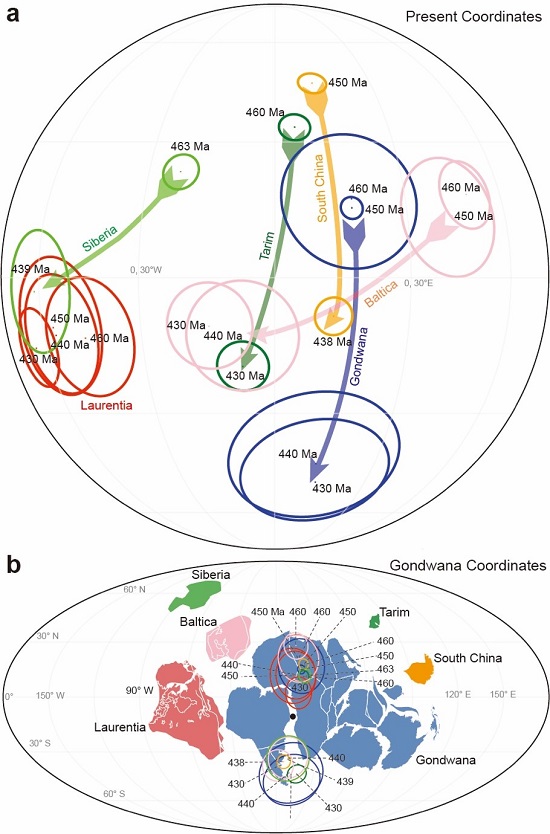
Figure 1 Paleomagnetic Poles of Major Plates 460-430 Million Years Ago (a: Present Coordinates; b: Gondwana Coordinates)
Based on this true pole wander, we accurately reconstructed the global geographical environment 450-440 million years ago (Figure 2), which well explains the development of glaciers and their causes in the late Ordovician Period. At the same time, rapid environmental changes caused by the true pole wander led to the mass extinction at the end of the Ordovician Period.
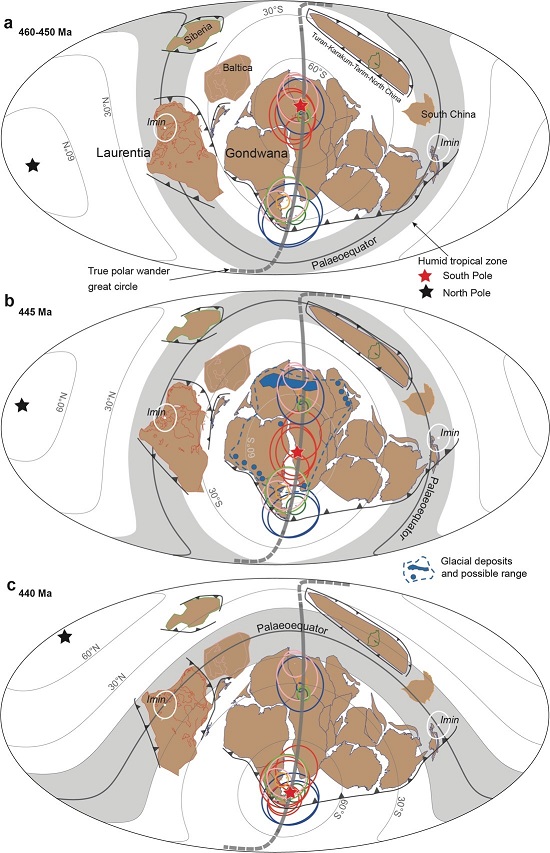
Figure 2 Reconstructed Global Geographical Environment 450-440 Million Years Ago
Lecturer Jing Xianqing from the College of Resource, Environment and Tourism is the first author, and Ross N. Mitchell from the Chinese Academy of Sciences is the corresponding author. Co-authors include Academician Zhu Min and Researcher Wan Bo from the Chinese Academy of Sciences as well as Researcher Tong Yabo from the Chinese Academy of Geological Sciences.
Link of the paper: https://www.nature.com/articles/s41467-022-35609-3
(January 3, 2023)