News
Opening Ceremony of the 2026 ASEAN China Centre Scholarship Short term Program Held at CNU
2026-08-14
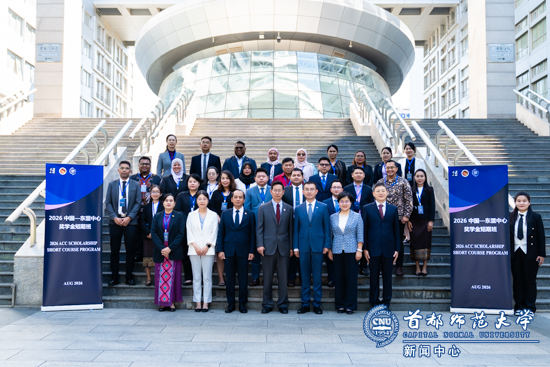
Number of hits:On August 14, the opening ceremony of the 2026 ASEAN‑China Centre Scholarship Short‑term Program took place at CNU. Co‑sponsored by the ASEAN‑China Centre, supported by the Center for Language Education and Cooperation of the Ministry of Education, and undertaken by CNU, the ceremony was attended by Ambassador Zhang Lizhong, Secretary‑General of the ASEAN‑China Centre, and other relevant officials; Wang Luozhong, Member of the Standing Committee of University Party Committee and Vice President of CNU; heads of relevant colleges and departments, as well as program participants. Jiang Guoquan, Dean of the College of International Education, presided over the ceremony.
In his address, Zhang Lizhong reviewed achievements of ASEAN‑China dialogue relations, comprehensive strategic partnership and the development of the ASEAN‑China Centre. He briefed on outcomes of this flagship project over the past three years and encouraged participants to make the most of the two‑week training to study China’s development practices and act as envoys for ASEAN‑China friendship. Expressing gratitude for sponsors’ support, Wang Luozhong introduced the university’s internationalized education and training of ASEAN international students. He stated that the university would deliver solid teaching and logistical support, hoping participants could translate gains from the “Chinese + Government Administration” training into governance capacity and contribute to building an even closer ASEAN‑China community with a shared future.
Tin Tin Htwe Win, participant representative and Director of the ASEAN Affairs Department from the Ministry of Foreign Affairs of Republic of The Union of Myanmar, thanked the organizers, noting the program offers a valuable platform for ASEAN officials to learn from one another.
Executed by the College of International Education, the short‑term program enrolls 23 government officials from nine countries including Myanmar, Laos and Malaysia. Centered on “Chinese + Government Administration”, it features thematic lectures on China’s national conditions, rural vitalization, green economy and artificial intelligence, field studies in Beijing and Dezhou of Shandong Province, together with intensive Chinese courses and cultural experiences to help participants understand China’s development practices from multiple dimensions.