

News
CNU Team Publishes Key Findings in Top Tier Journal Science
2026-09-25
Number of hits:On September 24, collaborative research outcomes from Professor Sun Cheng’s research group at the College of Life Sciences of our university were published online in the world‑renowned top‑tier journal Science. The paper reveals the escape of the BC200 gene into human poxvirus and verifies its persistent transposition in primates. It identifies a novel active transposon in the human genome, overturning conventional understanding of the boundary between transposons and functional genes, and carries great value for deciphering human evolution and disease diagnosis and treatment.
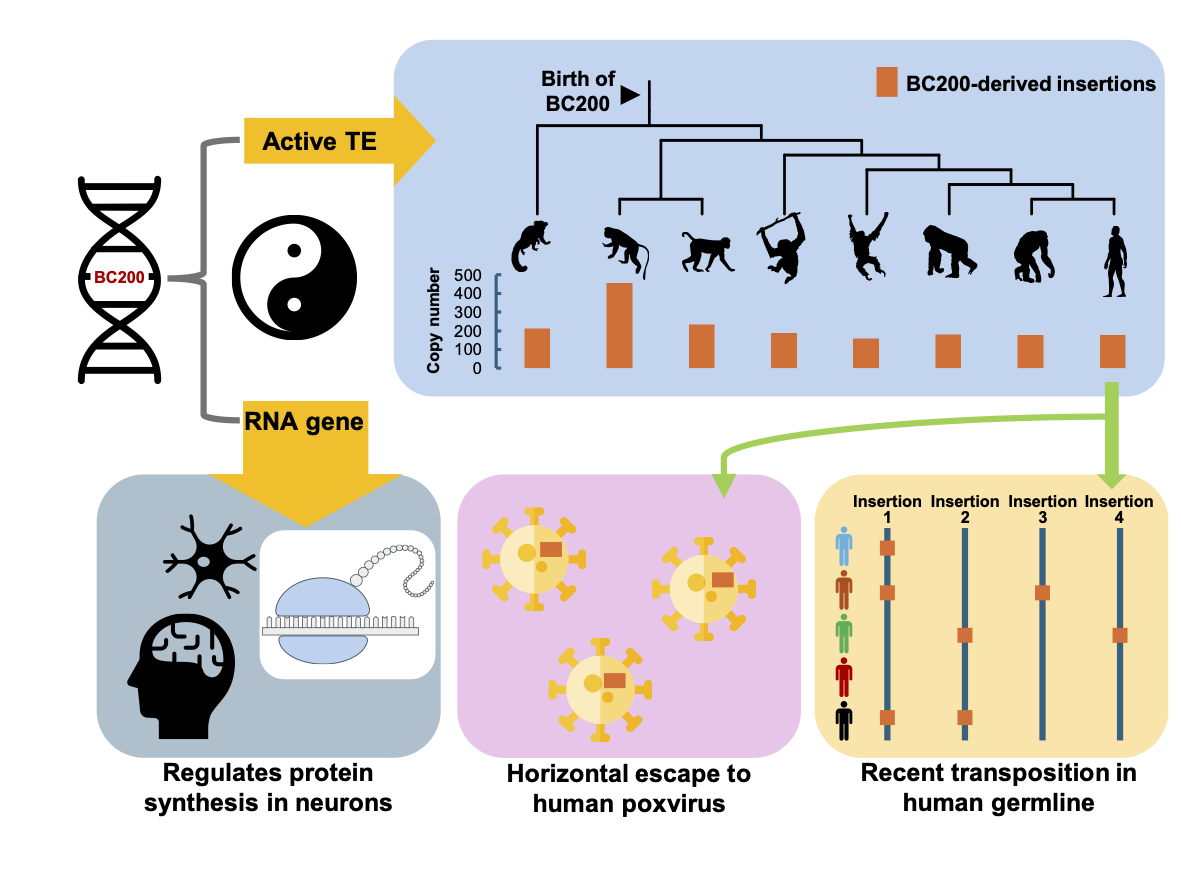
Transposons are mobile genetic elements within the genome. Most transposons in the human genome have lost their mobility, and no new active transposons have been discovered over recent decades. The research team identified inserted sequences derived from the BC200 gene in the molluscum contagiosum virus genome. Analyses of population sequencing data confirm that although BC200 was “co‑opted” as a functional gene regulating protein synthesis in neurons, it retained transpositional capacity. Virus insertions occurred within the past 150,000 years, and new insertion sites were detected in human populations. The study suggests that BC200’s retention of transpositional activity over tens of millions of years represents an evolutionary trade‑off, continuously supplying genetic variation materials for hosts.
CNU is the first‑affiliation institution for this paper. PhD student Gao Pu is the first author; Professor Sun Cheng serves as the corresponding author, with Professors Cedric Feschotte and Ellen Pritham from Cornell University as co‑corresponding authors. The research was funded by the National Natural Science Foundation of China. This marks the College’s third major original research achievement published as the first‑completing institution in leading international journals, following publications in 2009 and 2023.