News
2026 Opto Electronic Advances Symposium — Terahertz Technology Session Successfully Held at CNU
2026-09-08
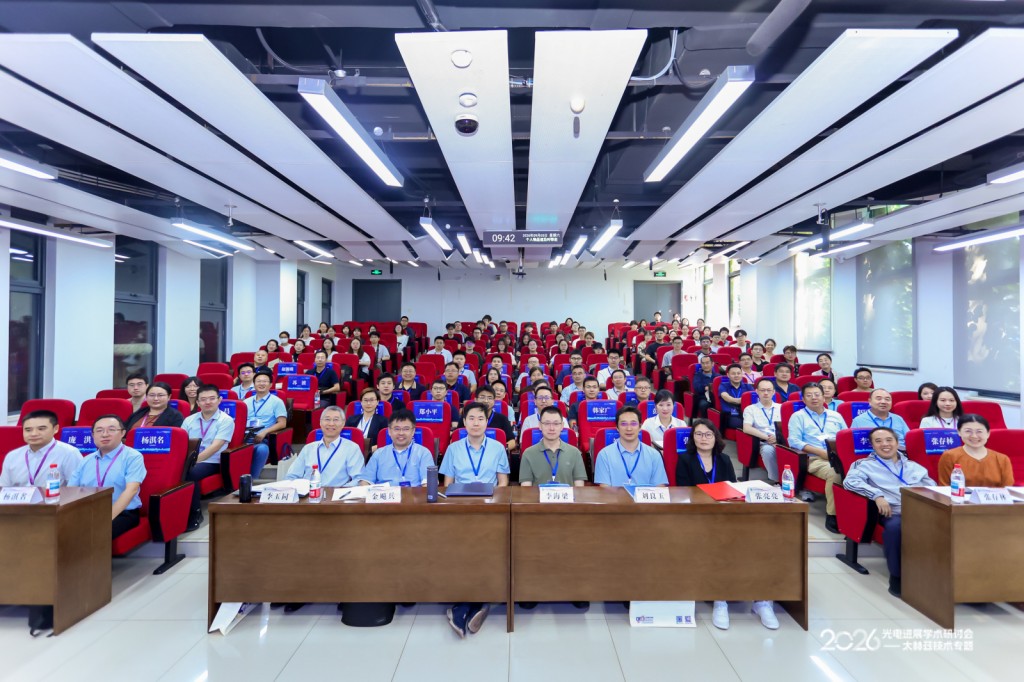
Number of hits:From September 4 to 6, the 2026 Opto‑Electronic Advances Symposium—Terahertz Technology Session was held on the main campus of CNU, alongside the unveiling ceremony for the Beijing Office of the Opto‑Electronic Journals Cluster (OEJ). Hosted by the Joint Editorial Department of the Opto‑Electronic Journals Cluster, co‑organized by the Department of Physics of our university and the Beijing Office of the Opto‑Electronic Journals Cluster, and co‑sponsored by the National Key Laboratory of Science and Technology on Light‑Field Manipulation, the event drew experts and scholars from institutions including the Institute of Physics of CAS, Tsinghua University and Peking University. Participants exchanged views on terahertz light sources, functional devices, detection technologies, biomedicine and mineral characterization.
The opening ceremony was presided over by Researcher Zhang Liangliang, Director of the Department of Physics. Professor Li Hailiang, Member of the Standing Committee of University Party Committee and Vice President, delivered an opening address. He noted the ongoing restructuring of the Department of Physics into a college and the layout of engineering discipline clusters. Leveraging the solid research foundation of the Key Laboratory of Terahertz Optoelectronics (Ministry of Education), he called for deeper industry‑university‑research collaborative innovation through this symposium. Pang Hong, Deputy Director of the Joint Editorial Department, briefed on the development of domestic opto‑electronic journal clusters and highlighted the significance of local scientific journals for achieving high‑level self‑reliance in science and technology. Yang Qiming, Editorial Department Director, and Professor Zhang Yan of our university jointly unveiled the Beijing Office, which will capitalize on disciplinary strengths to form an integrated chain of academic discussion, achievement publication and journal services.
Twelve thematic reports on terahertz theories and engineering applications sparked vigorous discussions. The symposium serves as a high‑level domestic exchange platform for terahertz research, and the new office pioneers two‑way empowerment between journals and universities. Moving forward, the Department of Physics will give full play to the key‑laboratory platform, strengthen interdisciplinary opto‑electronic studies, advance multi‑party cooperation for talent training, original innovation and industrial transformation, and contribute to building the Beijing International Center for Innovation in Science and Technology.