News
CNU Hosts 2026 Russian Language Day
2026-06-08
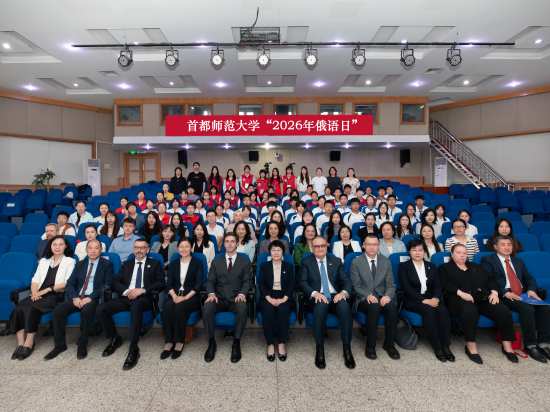
Number of hits:On June 6, marking the 227th birth anniversary of Alexander Pushkin, CNU held the 2026 Russian Language Day events. Igor Morgulov, Ambassador Extraordinary and Plenipotentiary of the Russian Federation to China, together with other diplomatic officials from the Russian Embassy, attended the activities. Cao Wenjun, University Party Secretary, Li Hailiang, Member of the Standing Committee of University Party Committee and Vice President, university administrators, teachers and students of the Russian Department, as well as representatives from multiple middle schools in Beijing were present. The ceremony was presided over by Wang Zonghu, Deputy Party Secretary and Dean of the College of Foreign Languages.
The event kicked off with Ambassador Morgulov laying a wreath at the Pushkin Monument on campus. As the only Pushkin monument in Beijing, it stands as a symbol of the profound friendship and cultural exchanges between China and Russia. In her address, Cao Wenjun spoke of CNU’s strong Russian discipline and the China-Russia Literature Center co-founded by the university. She stated that CNU would keep leveraging its strengths to advance the comprehensive strategic cooperative partnership between the two countries. Ambassador Morgulov spoke highly of CNU’s achievements in Russian education, literary research and people-to-people exchanges, and pledged to further expand bilateral cooperation across diverse fields.
Following the commemoration, a Russian poetry and music festival was staged. Participants delivered poetry recitals, instrumental performances and songs to appreciate Pushkin’s literary legacy and showcase their passion for Russian language and culture. In the afternoon, the inaugural Capital Forum on Russian Education for Middle Schools and a special Russian class for students were held concurrently.
As the year marks the launch of the China-Russia Education Year, the events integrate cultural performances, academic discussions and language practice. They have deepened China-Russia people-to-people bonds and boosted the coordinated development of Russian education among universities and primary and secondary schools in Beijing.