News
First National Symposium on the Undergraduate Program of Language Intelligence Held in Beijing
2026-06-18
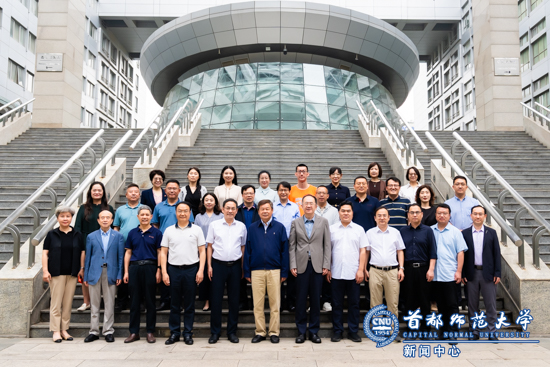
Number of hits:On June 16, the First National Symposium on the Undergraduate Program of Language Intelligence convened in Beijing, presided over by Cai Chun, Member of the Standing Committee of University Party Committee and Vice President of CNU. As the first national special forum after Language Intelligence was officially listed in the national undergraduate major catalogue, the symposium centered on core topics including major positioning, disciplinary system construction and talent training models, offering reference frameworks for universities nationwide launching this program.
Du Zhanyuan, Member of the Standing Committee of the National Committee of the Chinese People’s Political Consultative Conference, former Vice Minister of Education and former Director of the State Language Commission, delivered an address. He reviewed the decade-long development since CNU undertook the construction of the China Center for Language Intelligence Research in 2016, affirmed the strategic value of language intelligence, and advised the new major to align with national demands and integrate teaching with research, liberal arts with science and engineering, and theories with practical applications to cultivate outstanding professionals. Liu Peijun, Director of the Department of Language and Text Information Management of the Ministry of Education, stated that the inclusion of interdisciplinary language majors in the undergraduate catalogue echoes the advances of large language models and AI technologies, and interdisciplinary language talents will strengthen national language capacity and the national language service system.
Fang Fuquan, President of CNU and Member of the Chinese Academy of Sciences, presented CNU’s achievements in establishing China’s first doctoral program in language intelligence, and put forward three proposals for disciplinary development: pursuing high-standard development in response to national strategies, deepening integration between linguistics and data science, and building an open collaborative ecosystem for language intelligence education. The Leader of the China Center for Language Intelligence Research systematically expounded the theoretical framework and planning for the undergraduate major, and introduced the full-range disciplinary system built by the center since it proposed the concept of "language intelligence" in 2013 and launched the first doctoral program in 2016.
The President of Beijing Foreign Studies University shared cross-disciplinary training models combining foreign languages with big data. The Director of the Editorial Department of China Yearbook suggested that talent training should be closely linked to industrial application scenarios. Experts from Peking University, Renmin University of China, Beijing Normal University, Wuhan University, Shanghai International Studies University and other institutions offered constructive suggestions on curriculum design, enrollment policies, liberal arts-science integration and career prospects.
All participating experts reached a consensus that the Language Intelligence major should advance in-depth integration of liberal arts and sciences, develop a disciplinary and talent training system with Chinese characteristics, and contribute to building a stronger country in education, science and technology, and human resources.