News
A Teacher from Our University has been Elected as a Fellow of the China Society for Industrial and Applied Mathematics
2025-10-28
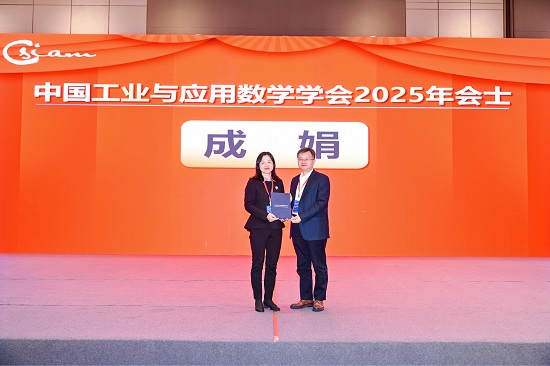
Number of hits:On October 24, at the 23rd Annual Conference of the China Society for Industrial and Applied Mathematics (CSIAM2025), Researcher Cheng Juan from our university's Academy for Multidisciplinary was elected as a Fellow of the China Society for Industrial and Applied Mathematics (CSIAM) in recognition of her outstanding contributions in the field of industrial and applied mathematics.
The China Society for Industrial and Applied Mathematics is a national first-level society in the field of industrial and applied mathematics. As a bridge connecting the mathematical community and the industrial enterprise sector, the society is an important force in promoting theoretical research, technological development, and achievement transformation in applied mathematics in China. The society's fellows are used to honor members who have achieved outstanding accomplishments in related fields, representing the highest academic honor of the society and a lifelong distinction.
Cheng Juan is primarily engaged in the research of numerical solutions to partial differential equations and high-precision, robust, and efficient numerical methods in fluid mechanics. As an academic leader at the Cross-Science Research Institute and the Beijing National Center for Applied Mathematics, her research in related fields provides significant support for the discipline layout and injects strong momentum into the development of applied mathematics research at our university.
Cheng Juan's election as a fellow of the China Society for Industrial and Applied Mathematics is not only a full affirmation of her personal academic abilities but also an important manifestation of the fruitful achievements in the construction of high-level talent at our university. This honor will further enhance the academic influence of our university in the field of industrial and applied mathematics, creating favorable conditions for attracting more top scientific research talents and deepening interdisciplinary integration. It holds significant and far-reaching implications for promoting the university's 'Double First-Class' initiative and achieving high-quality development in the discipline.