News
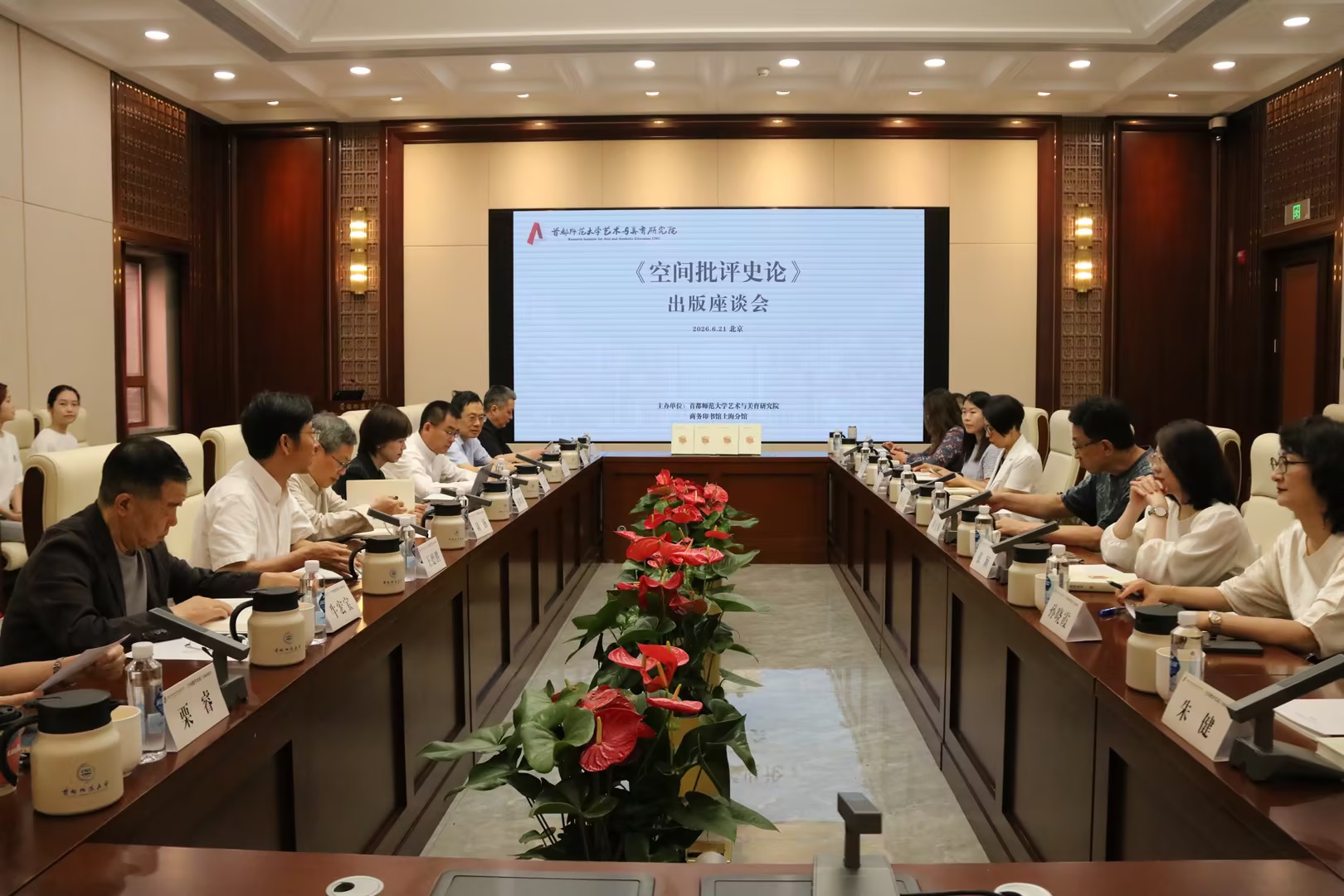
Symposium on the Publication of A Historical Study of Spatial Criticism Held at CNU
2026-06-24
Number of hits:On June 21, the Research Institute of Art and Aesthetic Education of CNU, together with Shanghai Branch of The Commercial Press, co-hosted a symposium on the publication of A Historical Study of Spatial Criticism , a new monograph by Lu Yang, Distinguished Professor of the university. Wang Luozhong, Member of the Standing Committee of University Party Committee and Vice President, attended the event and delivered an address. Nearly 20 experts and scholars from the Chinese Academy of Social Sciences, prestigious universities and research institutions gathered to discuss cutting-edge issues concerning spatial theories.
In his speech, Wang Luozhong noted that the university’s discipline of arts has achieved remarkable progress. Professor Lu Yang has greatly boosted disciplinary development by undertaking major research projects and publishing high-impact academic works. Integrating interdisciplinary theories with forward-looking perspectives and rigorous arguments, his new book offers valuable references for innovations in literary and artistic theories.
Lu Yang introduced that this book, an outcome of a major project funded by the National Social Science Fund of China, centers on the "spatial turn" in humanities. Adopting a chronological framework starting from Greek-Hebrew culture, it examines spatial narratives in canonical writers including Augustine and Shakespeare, and systematically elaborates spatial theories proposed by Lefebvre, Foucault, Yi-Fu Tuan and other scholars. It remedies the deficiency of textual neglect in contemporary literary theories and presents a thorough review of the evolution of Western spatial criticism.
Participating scholars unanimously recognized that the book spans literature, philosophy, sociology and other disciplines, delivering systematic and forward-looking interpretations of diverse artistic spatial experiences and filling gaps in domestic academic research. Propositions such as the mutual learning between Chinese and Western spatial theories put forward in the work carry great practical significance for constructing an independent discourse system for Chinese literary and artistic studies.